Here is my LEAP 2 video for EDC534!
Monday, February 27, 2017

Monday, February 6, 2017
My Media Memoir 2017
My Media Memoir 2017
It's not uncommon in New England or probably most parts of our country to have parents of different religious affiliations. In fact, I have a first cousin twice removed who has the same story that I do. She had a Catholic mother and a Protestant father and we both ended up going to Protestant divinity schools in Massachusetts. But in her case her father practiced and in my case mine did not. And that has been one of the ingredients in the recipe of my life and cultural heritage that for years made the taste seem slightly off. Eventually, one nut would be added back into the recipe to get the taste to be refreshed and understood anew.
So I have lived all of my life in Massachusetts but that lone fact or the brief vignette above has not necessarily helped me answer the question of “who am I?”
As a young person I had been familiarized by the traditional media of signs, monuments, and other markers that helped me get a glimmer of my own Anglo-American cultural identity because I knew growing up that my near namesake and great-great grandfather Daniel Luther Tucker and his father-in-law Conrad Spraker were buried across town in Spring Brook cemetery. But compared to the many other ethnic Americans I have encountered in Bristol County, USA, I do not feel that I have had enough to go on in terms of having a solid identity. I have had soup and bread at many a Portuguese festivals and similar events with local Greek, Egyptian and Italian enclaves but never had the sense of what it means to be an Anglo-American (working middle class person). It doesn't help being mono-lingual also. While I know the answer to this might be that dominant culture groups act and form this way and so there's no identity to find but I think that is an oversimplification.
I knew the name of Daniel Luther Tucker's son George Spraker Tucker and knew that through his wife Edna Delano our family was distantly related to FDR. But that was about it. My father's aunt Edith lived until 1999 and was a pleasant person but we never talked about anything related to family more than her generation or one back from her. My dad's first cousin Bob, only gone a fews years now, the aforementioned Protestant father in my introduction, had a unique story of competing loyalties in his life so the Tucker side of his heritage was eclipsed by the Foster side. But growing up I had two competing stories of cultural and religious commitment. Bob and Edith, and a few others aside, we didn't see to much more of my dad's side of the family on a frequent basis. And despite my mother being an only child, it was the armies of French and Irish Catholic relatives, all of the Rheault's and Conroy's, that we regularly visited or were visited by during my childhood and early adolescence. It was a full cast of characters. Anna Conroy, my Irish great grandmother died in 1977 at the age of 99, just at the time by which I had locked in vivid memories of visiting her and my great aunt at their home in Roslindale, located at the highest point in Boston, on a side street off of the great incline that is Metropolitan Avenue. I met Madge there, an Irish cousin, who visited two three times during my early years. I met the majority of my grandmother's eight brothers and sisters and saw them again at the various funerals and anniversaries that followed rather quickly after my great- grandmother's death.
On the French side of my mother's family we saw cousins and aunts and uncles on a less frequent basis, as they all tended to live in points north of Boston and we had always lived south of the city. But it was my grandfather and grandmother's involvement that would be vital to me being a Catholic and by all accounts a zealous one, all the while bearing this English (Protestant) last name. Visiting my maternal grandparents and staying overnight with them for a day or two was the full on Catholic media practice and production. We bolted to Daily Mass Saint Anne's Church in Hyde Park right out of the starting gate (pre-breakfast of course!). We sat in the second row behind the middle aged man in the red sweater who had wobbled in place during the whole liturgy. We returned home for breakfast in Dedham and went about the regular routine of a few chores in the house and a bike ride through the hills of Dedham and everyday was closed by the recitation of one mystery of the Rosary while kneeling beside my grandparent's bed with the massive gold colored Douay Challoner Catholic Action Edition Bible open to some page with a fully painted picture of a New Testament miracle on one side of the page or the other.
Despite this Catholic media immersion my grandfather was the one who bankrolled my nursery school tuition at the only available location in Mansfield, the Congregational Church. Granted, I was not going to be swayed by Protestant doctrine at the age of three, but this was an a
choice from the same man who sent my mother to Catholic primary and secondary schools out of a sense that failure to do so would be the loss of his own salvation. Were he to know that it might be a portent of things to come and that the other bookend of my formal education
was Andover Newton Theological School, the Congregational seminary, he might have felt differently.
But I grew up, attended Sunday Mass all along the way, and I was eventually encouraged to attend a divinity school by a Catholic priest while at college (thinking I could teach or be a good candidate for the State Department) and eventually began my teaching career in Catholic high school theology departments. Now it was there that it became clear it that it would mirror parish life in that I would be the only one of a few at most who's last name was clearly not Irish or Italian. Not long ago I taught with three Italian American's in the same department and one of them joked that the department should just be renamed "Goodfellas".
So granted, I had been steeped in the Continental and Hiberno European cultures all of my life but had felt that there was something missing in my self-understanding about my heritage. But that started to change quickly seven years ago when I visited my parents one afternoon.
They had come into possession of a document that would set me off on a mini-media adventure that recast myself understanding and relationship to my surroundings. As usual that afternoon my mother put the kettle on for me as she did for my Irish American grandmother when she lived with us in her declining days. Tea seems to have always been the linking theme between my Irish and English ancestries. What else would or could be? Well as I said earlier, it was a nut. It was Almond Tucker. As I’ve said before I knew about all of the recent Tucker generations at least in outline form. But I had at the time a limited sense of my own abilities to find anything else and a few dead end searches online seemed to cement this barrier to further knowledge. Ironically, the nut, Almond Tucker, cracked that prematurely cemented barrier.
The document in question was Daniel Luther’s death certificate and listed his father Almond on the document. That was a new name when it rang in my ears. I immediately got a sense of what was possible in returning to research I had given up on not long ago. My curiosity was now at a fever pitch and when I returned home I was eager to look up his name and did indeed find that there was substantial reference to him in local history and quite an amount of work done by those who shared him as a common ancestor.
So in about five months I was able to visit numerous websites to trace the Tucker lineage in many directions. Importantly, it became clear to me that I could shift from being a digital reader or consumer by finding this information to becoming a digital author. I recall from last semester’s Digital Literacy Seminar with Dr. Julie Coiro that an internet reader reads and creates a new unique text into existence by taking his or her own course throughout the various hyperlinks he or she chooses to follow in the pursuit of knowledge. I knew this would be the case for me also as I would be creating a genealogy that would include its own unique subset of persons (my children) and that it would be a unique document in that I would be likely emphasizing a set of relationships no other person could make.
So yes, I confess, and I realize now seven years after beginning the genealogy there is unquestionably a degree of self centeredness in the approach I took to making it.
For while I modelled my work on that done by others, distant relatives, who were comprehensive in their work I choose not to focus on any cousins, aunts or uncles. Yes, I found delight every time I would use the internet or the genealogical records to find a direct ancestor either through patrilineal ar matrilineal descent. And more to a point, I was looking to find as far back as I could with direct descent with the Tucker line. I have to admit it was a sheer genetic greed that possessed me when composing the genealogy and attempting to believe it was possible to go back to pre-Reformation times in England. That would of course mean I would be looking at Pre-Reformation Catholic Tuckers. They may have been Lollards (followers of Wycliffe) but I do not want to think that. So when it comes to the year 1678 and the origin of the first Tucker’s in America I wrestled with which other genealogy to follow and even accept some contradictory or ambivalent evidence that would ensure my landing back in England with an intact Tucker line. Yet some of those webpages and other sources spoke of this or that Robert or John Tucker being born in Weymouth or Milton, Massachusetts but dying in places like Bermuda. As memoir has creativity and a bit of license, I know genealogy really cannot be constructed in that way. I have this sense that the temptation to have the various records be something that I can master for my own ends as opposed to letting the facts master me I came face to face with the true nature of critical literacy as really is. Buckingham states that it involves, analysis, evaluation and critical reflection. (Buckingham 2003, 38) In all my years of divinity studies I never really felt the need to dispense with any one or all three of these critical processes. But it was now apparently all worth it to make this genealogy right.

That all being said, it is clear as I reflect on this now and that I have given a position of privilege to my own last name it is only a way to direct one’s attention to an accident of history. Who am I? Yes, I’m a Tucker and a Priestley and Delano and a Hathaway, Eddy, Allen, Weed, Davis, Hinckley, Spraker, Newland, Simmons, Hunt, Copeland, Eddy, Hinckley, Samson, Standish, and Alden, etc. etc. etc. etc…..
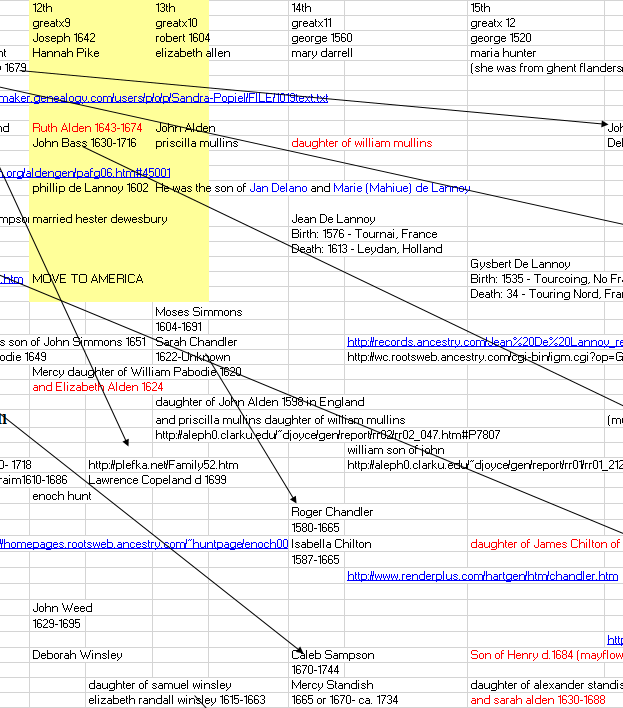
And before I continue on with the last name on that list, Alden, I want to address the new media frontier for me in all of this. Since I was focusing primarily on direct descent and I am most certainly a visual learner I decided that putting everything I found on a single spreadsheet page. The web of relationships to me was the main attraction to be seen. Granted, I found much information from the work of distant cousin (probably an eighth or ninth cousin) and I was impressed by the thoroughness of his work and his genealogical procedural precision. He has properly numbered everyone as one should in composing a genealogy online, using proper pages to distinguish generations. It’s clearly an impressive and comprehensive work. I found that I wanted to use Excel because it meant a visually striking and complex web could be viewed on one page. Of course I discovered there are trade offs in doing this. It means drawing a bunch of lines off of various lines to capture the complexity of different lines or going ahead and making patrilineal or matrilineal lines branch down from previous rows with the flip side of that gambit being that the spreadsheet would be enormous and unviewable in another way. Either way, my consciousness as a writer and author. Granted, I was happy to learn about my own personal narrative, expository and poetic strengths when I took the course Writing from Soul with Nita Penfold at Andover Newton in the summer of 2008. But in this case becoming an archivist, a researcher, an organizer, and somewhat of an editor seemed to be empowering and ennobling in a new way. In the early 2000’s my only experience with MS Excel was limited to being the debate league statistician and manager of our household finances, both of which were about cultivating new types of headaches than it was about getting acquainted with a new type of knowledge and a new type of data organization. Since I first laid my eyes on that death certificate to the time when I retitled the file I was storing all my information on was about five months. At the time my youngest child was five years old and the house was a busy place filled with the laughter, energy and conflict you would expect in house with three little boys. But when I carved the time out to keep generating the spreadsheet genealogy after the boys were put to bed, I had a keen sense of flow in putting it all together.
On some level I do not share the priorities with that distant cousin who provided me with so much work but his work did also help me reach my goal of having a deeper meaning for the Anglo-American identity that lurked beneath the surface of my conscious life. And even though I would find numerous Anglo-American ancestors as he did, I came to understand that the Protestant heritage was actually more determinant in my existence in spite of all the Englishness. I saw that just a few years generations back that my families of origin had regularly been willing to be intermarried with Germans, Swedes and notably, as I will explain later, the Dutch. And of course all of those peoples in the nineteenth and twentieth century were Protestants.
However, so while my Anglo-American identity has not been clarified with these discoveries and connections, I have now come to realize more concretely what it means to be a New England Yankee. For it was easy to find the Delano line online and trace it back to before the time Delano was Anglicized from De Lannoy, the last name of the young Dutchman, Phillippe, who came over on the Fortune in 1621. And more importantly, when checking my distant cousin’s work it took a number of days to get through my thick head that John Alden was a name that should have been more familiar to me. That was the big one! A Mayflower ancestor, in light of his many children and illustrious career, THE Mayflower ancestor (or so I thought for a brief time). But as it turns out I could find and organize more and more names. When all was said and done I could identify six distinct Mayflower names of people who were my direct ancestors; Chilton, Samson, Standish, Cooke, Mullins and Alden. Of course if there was one it makes perfect that there were six. So I placed them on the spreadsheet and set them off as unique by labelling their names in red. I had done similarly when accounting for immigrants the best I could with a line extending top to bottom of those who crossed over from England (or in this case, the Netherlands).
I had add further red to the genealogy as the well known John Alden did not provide me with a daughter to be my great xth grandmother but three. So Elizabeth, Sarah and Ruth Alden all married men who would eventually have descendants who would intermarry with other cousins to produce me and thousands of others. I mention this because I think it’s with this visualization of the data on a spreadsheet it seems to make sense of my Anglo-American, specifically Yankee, identity. I don’t call Framingham and Natick Central or Western Massachusetts as some do in the eastern half of the state but it makes it clear to me the degree of rootedness I have in this area. Since the Mayflower landed 397 years ago I’ve been able to move my ass all of thirty one and a quarter miles to the west of the Alden House in Duxbury. This rootedness may be inescapably deep. After putting this all down electronically has motivated me to get a closer lay of the land and just now to measure out things I knew were significant. I was baptized at St. Mary’s in Norton all of one mile away from where Almond Tucker was buried in 1865 and his father Benajah was buried four years prior. I have read Kevin Leman’s books on birth order and I always had the impression that as a first born son I was meant to most likely “stay in orbit” around my parents and be family oriented. Yet when I look at the Tucker genealogy and the patrilineal descent and compare it with the online resource I could find such as Representative Men and Old Families of Southeastern Massachusetts: Containing Historical Sketches of Prominent and Representative Citizens and Genealogical Records of Many of the Old Families of Southeastern Massachusetts. Vol. III. it became clear that with exception of my father, grandfather and great grandfather, the Tucker men have been in northern Bristol County since arriving from England in 1678. When my wife in and I moved in 2014 within Bristol County I joked that even though we looked at houses further north, somehow an invisible barrier prevented us from leaving Bristol County. We are now just about four miles west of where Almond and Benajah lay resting.
I think that one final insight that comes to me from creating this spreadsheet genealogy to share with family and interested kindred spirits has been to know the continual enduring power of privilege. I am a white man living in the twenty first century studying mainly white men going one, two or three centuries back. And so I now have about two hundred people listed in the genealogy and I do want to revisit it again to make some organizational streamlining. Yet ironically the male privilege that I possess in life today and those of my forefathers came into sharper focus in attempting to give Almond Tucker’s wife, Betsy Hathaway, the same due diligence I gave to others in the list. Betsy was from Dighton and had eight children with Almond, but nothing is available on her origin whatsoever. This motivated me enough to be as multimedia oriented as possible and use every public website and the archival books and town records of the Dighton Public library, which one would surmise would have a little more information in it’s Vital Records collection than other towns. Alas, it was not meant to be. My first thought after running into dead ends in search of Betsy was that it may only make sense that daughters were simply not as valued equally to sons in tracing lineages because of property rights and the social customs of the day. I gather that being an amateur genealogist and professional information scientist in the twenty first century along with being this hybrid Euro-American Catholic believer Yankee Protestant cultural warrior all call me to be a dignitarian who will attempt not to discount anyone, especially in a day and age when women seem to have a new fight for equality brewing that needs allies and equal partners.
Buckingham, David. "Media Literacies." Media Education: Literacy, Learning, and Contemporary Culture. Cambridge, UK: Polity, 2003. 38. Print.
Buckingham, David. "Media Literacies." Media Education: Literacy, Learning, and Contemporary Culture. Cambridge, UK: Polity, 2003. 38. Print.

Monday, January 30, 2017
About Me in 2017
In this post I'm introducing myself to my classmates and professor, Dr. Renee Hobbs, in my URI Digital Authorship Course running January 2017 to May 2017...
I'm a mid-career theology teacher (18 years). I'm a lifelong Bay Stater and a lifelong Roman Catholic though I went to an interdenominational divinity school, Andover Newton. I currently teach at an all boys Catholic high school in the Greater Boston area with a specialization in ecclesiology (a course on the Church) and ethics. I am also the speech coach co-moderator. I have been interested in media literacy and cultural criticism for a very long time, reading authors such as Christopher Lasch (The Culture of Narcissism) and Paul Wachtel (The Poverty of Affluence) at a rather young age.
I figured I'd eventually get a Doctor of Ministry degree since I take graduate courses every other summer or so. In the spring of 2015 I stumbled upon a media literacy course at Rhode Island through an online search. I took it and I loved it. I was the smartest man in the class! (I was the only man in the class with fourteen women and female professor.) Well, that really piqued my interest so I started searching for other courses to expand beyond that one, hoping to come accross a certificate program. I found a school in Boston running a graduate certificate but they were unresponsive and then called back weeks or even months after my first couple of inquiries only to have someone call me back who was unable to really give me any specifics on the program.
Well, not long after that I found the URI Digital Literacy Institute and certificate program. And the Feinstein campus is only 30 minutes away from home by train and a quick walk. I am delighted to be half way done and excited about this course and the tier two leadership course in the summer of 2017. I look forward to getting to know my EDC534 classmates and responding to the intellectual and technological challenges Renee gives us this semester.
Wednesday, October 19, 2016
A reflection on New Literacies
Online Reading Comprehension: Digital or New Literacy(ies)?
LABELING AND DEFINING LITERACY IN 2016
Regarding the use of the terms digital literacy singular or plural and the terms new literacies,my understanding of Hammerberg’s work points to an answer to the question of of plurality or singularity in that one should question, the scope of the media, the culture involved and the type of media itself that needs to be examined for decoding, coding and fluency. Hammerberg also sees that there are a set of assumptions that privilege certain media, primarily print media: “including, but not limited to, assumptions about (a) the power and necessity of a particular kind of print literacy…” It would seem to me that such a bias would reinforce the hegemony of the world view of the most literate of cultures (who also happen to have been superpowers in the last two hundred years), Great Britain, Germany and the United States.
Another reason for speaking in terms of plurality or singularity is addressed by Alvermann in which she makes clear that only certain types of studies are accepted in understanding literacy. So I think it’s clear that the plural language and modelling is more accurate because the cultural and professional bias is likely to not to enjoy the reality that life is messy and the non-antiseptic approaches certain theorists take, like my LEAP scholar Brian K. Street are onto something with their multimodal receptivity to literacy however it comes to the open minded researcher. Brene Brown’s TED Talk on the Power of Vulnerability is a good counterweight to the theorists and institutions Alvermann names as too selective. Brown wanted results for her research that could be organized and put into a Bento box. She discovered much more when the dust didn’t settle.
- What are some of the things that some people believe are “new” about literacy and would you agree or disagree and why?
I think one of the most powerful demonstrations of the “new” is what Julie Coiro and Elizabeth Dobler identify as the shift in reading from “not only purpose, task, and context but also as a process of self-directed text construction (Coiro & Dobler, 2007) that occurs as readers navigate their own paths through an infinite informational space” This is “intellectual capital” at a speed before unknown (I speak to the other side of speed later) but also in a most democratizing fashion. Whereas banks “lend money into existence” our online reading generates new texts into existence and that can be done in the service of the common good.
- Is there any benefit to talking about these processes as online reading comprehension or digital inquiry, or does it create more confusion?
I don’t think it makes more confusion to use either of these terms as they both describe processes that are unique in relation to each other and unique in terms of their outcomes. Julie Coiro’s presentation at Medellin included enough statistical evidence and rationale one might need to rightly judge that online reading comprehension has its own form, its own set of challenges and its own opportunity for learners.
- Does the use of uppercase and lowercase ways of thinking about new literacies (as described by Leu et al, 2013) add clarity or muddy the waters? Which term do you prefer and why?
I don’t think the two styles of naming this emergent discipline are problematic. In a world that has as many institutions of higher learning as it does, we need to name complex realities with complex sets of terms. The general principles listed as the main outline of New Literacies studies need to be enunciated by a group of scholars who want to think holistically and paradigmatically, hopefully with the willingness to adapt to what new technologies will bring in the future to fine tune or even invert assumptions. It seems to me the terms New Literacies and the lowercase counterparts are analogous to the struggle Brian K Street and other ethnographically oriented researchers have with the more ivory tower type theoreticians. Street and others like him are willing to do the same type of work lowercase new literacy practitioners do that ultimately inform.
IMPLICATIONS FOR TEACHING AND LEARNING
No matter what you call them, do you think the online reading/digital literacy skills, strategies, practices, and mindsets outlined in your readings from Week 4 and 5 are more, less, or equally important for today’s students compared to those related to offline reading comprehension, vocabulary, and/or fluency (as discussed in reading from Weeks 1-3)? Please explain your reasoning. How might your new thinking about these ideas impact the way you design and implement your instruction of digital literacy and/or online reading comprehension?
In order to answer that question I think it’s necessary to consider how little traditional reading students are doing today beyond that which is assigned to them by teachers. My context again, is an all boys Catholic high school in the Boston area. I have taught both honors and accelerated classes for the last seven years of my eighteen year career. Students I have encountered seem to read less and less each year. Asking them if they read anything during the summer for pleasure usually comes with the same answer in the negative. So I think that it is equally important to learn these new skills as it is to learning how to succeed offline reading comprehension and fluency.
When I look back at Duke and Pearson’s (2002) list of practices of good readers I see a very impressive list of skills, ones I know are within reach of the vast majority of human beings. But the New Literacies list of principles does not seem to recognize a single problem or trade off that constitutes the existence of the Internet. Stating that the Internet is deictic is descriptive and not evaluative in any philosophical or moral sense. Through certain moral lenses one could say that the Internet’s deictic quality is a form of relativism, where everything is dependent on everything else but there are no first principles where does that lead us? If the Internet is just one vast semi-organized digital encyclopedia, that does fit into one model of Alasdair MacIntyre’s Three Rival Visions of Moral Enquiry: Encyclopaedia, Genealogy, and Tradition. Is that a naïve assessment in that it does not take into consideration the power of certain search engines, certain websites and certain corporations to thinly veil their own intentions for such a large swath of humanity (considering the 2.4 billion figure quoted in the article by Leu, et. al.)
A second problem or dynamic not mentioned in the New Literacies list of principles is that accounts for spatial dimensions, and one time dimension “The Internet is this generation’s defining technology for literacy and learning within our global community.” But never mind the dimension of a generation for a moment and consider the Internet and the instant. And this goes back to my original point about my owns students. Is the Internet good, bad or both, when it comes to instant gratification and fostering or reinforcing impatience in individuals and society? I enjoy the benefits myself very much but I have had arguments with students who have been asked to use an online database with a peer reviewed article as opposed to just getting the first pdf of an article by someone who has an opinion and just maybe a scholar. That being said, I’m not looking to design curriculum, lessons or that would exclude online reading, but I would want students to see that the whole continuum of media currently remains worthwhile in having exposure to and that more up-to-date online sources with multimedia embedded may do a good job in highlighting the static or stagnant information found offline in older sources. My ultimate concern I think is not in the collection of data and how that may be highly efficient with access to the Internet, but rather that in taking to heart the work done by Duke and Pearson in formulating a clear set of human skills that absolutely crucial to strong comprehension, students are not given the opportunity to NOT take apparent short cuts in the acquisition of knowledge and skilled literacy. While Duke and Pearson do not delineate the time required to master any one of the skills they list, it is clear that it does not happen in the same manner or same speed at which we can find plenty of content on any topic, issue or interest. If there is a Slow Food movement http://www.slowfood.com/ and some have argued for a Slow Sex movement, http://www.commondreams.org/views/2008/02/09/slow-sex-moving-toward-informed-pleasure
Then why not have a Slow Online Read Movement that allows the traditional skills find their way through this kaleidoscope of online information.
Alvermann, D. (2003). Exemplary literacy instruction in grades 7-12: What counts and who's counting. In J. Flood and P. Anders (Eds.), Literacy development of students in urban schools: Research and policy (pp. 187-201), Newark, DE: International Reading Association.
Coiro, J. (October, 2013) Online reading comprehension challenges.
Brown, Brene. "The Power of Vulnerability." Brené Brown:. TED, June 2010. Web. 19 Oct. 2016. <https://www.ted.com/talks/brene_brown_on_vulnerability?language=en>.
Castek, Coiro, Henry, Leu, & Hartman, 2015) Research on Instruction and Assessment in the New Literacies of Online Research and Comprehension.
Duke, N.K. & Pearson, P. D. (2002). Effective practices for developing reading comprehension. In What Research Has to Say About Reading Instruction, 3rd edition. International Reading Association.
Leu, Kinzer, Coiro, Castek, & Henry, 2013. New Literacies: A dual level theory of the changing nature of literacy, instruction, and assessmentMonday, October 10, 2016
EDC 532 (URI, Fall 2016)
Introducing the work of BRIAN STREET!
Brian Street's literacy research is a practice of humility. Thus it's no surprise when he relates his adventure practice to students via the Global Conversations in Literacy Research program that he includes the Buddhist story of the Turtle and the Fish. Street comments on that tale and explains that the premise of the story about the impossibility of the fish knowing about dry land is analogous to the impossibility of the methodologically armoured researcher knowing about the actual culture or form of literacy already present in front of them in a different (and assumed to be primitive and/or inferior culture). https://www.youtube.com/watch?v=rFKPiGgNJ4E
When he describes his ethnographic studies in India, Ethiopia and Uganda, he is keenly aware of how he literacy practice and research needs to be bi-directional in order for him to not replicate the methods and agenda of other “literacy experts”. He comes close to painting such experts as Promethean miracle workers who visit cultures that need to be “made literate”. If I had to pick one word that would begin to encapsulate Street’s methodology and scope of his discoveries, it would likely be the word attunement. The best illustration of that attunement is his own narrative on teaching literacy in India in his ethnographic study. The interaction that inaugurates that study is Street’s own request to be taught his own name and the name of his own locality, Brighton, in the Indian language whose context he studies.

So one could find much overlap in the methods Street uses and the work of Paulo Freire as the New London Group of scholars, to whom Street belongs, is known for advocating social justice as one of its defining characteristics.
While critics of Street and his group members may frequently say he has a methodology but no conceptual framework, evidence can be found to support the notion that Street’s conceptual approach is about correctly naming literacy skills (or to use true names, to borrow a phrase from American fantasy and science fiction author Ursula K. Le Guin), not necessarily making them be principles or phenomenon that must therefore be found in the next round of research. He does this in two ways.
First, Street has made it a point of discovering or recognizing what he calls hidden literacies. These are cultural cues, habits, and non-verbal, and unwritten behaviors that also carry a capacity for language fluency and literacy. But when recognizing the nature of his work and his witty verbal demeanor these hidden literacies. would probably be better to call them “hidden in plain site literacies” because of the preconceptions of researchers who tune out the apparently obvious distractions when seeking understanding. Street’s approach clearly demonstrates how he is eager he is to invert that dominant methodology and truly be attentive to the process of study by being taught by Indian women, examining the continued use of the three Ethiopian scripts (Latin, Amharic and Ethiopian) and the political prohibition of posting signage in Ugandan culture. For Americans as a whole, the last decade or two seems to have opened up enough space in our cultural fabric to acknowledge these hidden literacies. In popular culture that has happened with the film and the short lived television adaptation of Outsourced, the story of an American call center manager Todd Dempsy/Tood Hamilton, who is relocated to India so that he can keep his job. His interactions with his subordinates and neighbors reveal so many of these misunderstandings which are ultimately hidden literacies that would appear but trivial or primitive to the average North American. The book American Veda: How Indian Spirituality Changed the World by Philip Goldberg has done much of the same work in helping readers explore the same theme and helps the otherwise skeptical Western thinker discover, oh, that seemingly odd or esoteric idea has been here with us in America and subtly changed us without our even knowing.
His second practice and insight flows from the first. Street stains out the over use of the word literacy itself as a catch all term because it has been used to include images and other nonverbal phenomenon. He raises a pointed question on this topic:”Do we really want to reinforce the ominous implication-- already in the air-- that all intelligence and skill means correctness with letters and writing?” (Elbow) So it appears that Street here again takes elitism to task and his thought seems to resonate with Howard Gardner’s multiple intelligence theory in that it does not limit intelligence to the linguistic and logical domains, reduced in scope even further by the expression of that intelligence in text.
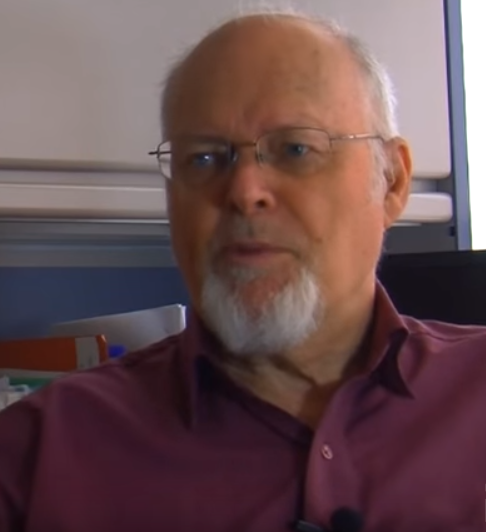
Finally, in a rather symmetrical fashion to his affirmation of the local language is his criticism of the agenda of a scholarly consensus that finds its formulation and universalizing adaptation through the community of scholars (who of course are mostly found in developing nations). So he has also raised a number of vital questions on this topic.
"What is the reality of international co-operation in literacy?"; Is internationalism damaging to local cultures? How can the local be protected and enhanced by approaches of national and international agencies to literacy? How can international co-operation be promoted in such a way as to sustain local identity?” (Street, 1993)
The questions acknowledge the power relationships of those who would define literacy based upon cultures that manifest hegemony already in terms of linguistic, cultural and international politics.
I am a social-justice oriented Roman Catholic theology teacher. I find Street’s approach to be holistic and humanistic (in line with the Catholic humanistic subfields of Benedictine humanism and Ignatian/Jesuit humanism). His critical approach in either presented personally in webinar form or in print does not make power the only dynamic in literacy studies and therefore fall into Marxist excesses or other ideological traps. He seeks to illuminate the ideologies that are already there for the service of all human beings whom he clearly holds as equals.
References
@GCLR_GSU. "Brian Street-April 27, 2014." Global Conversations in Literacy Research. Global Conversations in Literacy Research: A Series of Web Seminars H, 29 Apr. 2014. Web. 10 Oct. 2016. <https://globalconversationsinliteracy.wordpress.com/past-webinars/upcoming-speakers-2013-2014/brian-street-april-2014/>.
Elbow, Peter. Vernacular Eloquence: What Speech Can Bring to Writing. Oxford: Oxford UP, 2012. 344. Print.
Kelder, Richard. "RETHINKING LITERACY STUDIES: FROM THE PAST TO THE PRESENT." Literacy.org. University of Pennsylvania, Graduate School of Education, 1996. Web. 10 Oct. 2016. <http://www.literacy.org/sites/literacy.org/files/publications/kelder_review_of_lit_studies_96.pdf+>.
Simbawonwon. "Outsourced Culture Shock." YouTube. YouTube, 16 Dec. 2014. Web. 10 Oct. 2016. <https://www.youtube.com/watch?v=hGKCkvNk_zI>.
Street, Brian V. "Autonomous and Ideological Models of Literacy:Approaches from New Literacy STudies." Media Anthropology Network. Media Anthropology Network, n.d. Web. 10 Oct. 2016. <http://www.philbu.net/media-anthropology/street_newliteracy.pdf>.
Street, Brian V. "Rethinking English in British Schools." Youtube.com. Facultih, 27 Nov. 2013. Web. 10 Oct. 2016. <https://www.youtube.com/watch?v=rLfyM0NWEDY>.
Street, Brian V. "What Do We Mean By "Local Literacies"?" Conference on Sustaining Local Literacies: People, Language and Powerh. Proc. of What Do We Mean By "Local Literacies"?, Reading, UK. 1993. 2h. ERIC: Institute of Education Sciences. US Government. Web. 10 Oct. 2016. <http://files.eric.ed.gov/fulltext/ED359842.pdf>.
Saturday, September 24, 2016
Strategic readers (URI EDU532/Fall 2016)
In the last two weeks, the cognitive measure of strategic reader’s acquired target skills have stood out most in my mind. I know this is starting backwards to consider what it means to be a strategic reader. But those targets from the NAEP Reading Framework have helped me to examine assumptions I’ve never had the courage to consider before. In my current context I would say that we gear up students to be strategic test takers. PSAT, SAT and other standardized test preparation is discussed and given some reasonable amount of time in order for our students to succeed. It is the final exams, however, that are the perennial benchmarks of student recall skill and teacher accountability. I have really yet to see a theology final exam that ever mirrors the Grade 8 or the Grade 12 Cognitive Targets (p 9, NAEP) in its form and layout. Ultimately, locating and recall, the lowest or most simple target is one that takes over an exam and does not mirror the 20% recommended expectation of that competency. In our Moral Theology course this changes somewhat and moreso for our highest performing students, but I can only speculate that English final exams work their way toward more integrating, interpreting, evaluating and critiquing. I don’t think cramming would be such an issue for high school students I see working now and the way college students still do the same. A quantifiable number (a raw score) seems to take on it’s own mystical power as a measurement of “something” which must have been legitimate because it mirrored the content of the course (without considering what cognitive capacities we should have considered in the first place.)
I have found that identifying strategic readers and I guess this must mean strategic listeners also, is that they have this wonderful capacity Buehl lists in the comprehension process of proficient readers: making connections to prior knowledge. I teach two grade levels normally, sophomores and juniors. Yet the sophomore class is an honors class while the junior class is designated accelerated (unmentionably, the lower level). It is with the proficient readers and/or listeners I find that I will have students throughout the year who effortlessly refer back to the very first week of class or the very first historical unit and verbalize a direct correction to prior knowledge. On the accelerated level we teach foundational moral theology for about a half a school year and then applied issues (social justice, sexuality, life issues, war, crime, etc.). For many in that level the first half of the year becomes a distant and unrelated set of propositions even though it was intended to serve as the common vocabulary and language for all of those succeeding issues. And trust me, in light of it being a Morality course at a Catholic high school, there is really no other way to roll it out in terms of the institutional responsibilities we theology teachers have. But returning to the theme of prior knowledge again, I find that with that same theme I can activate connections for students by modelling that behavior in real time (the first part of the reciprocal teaching process) by connecting our just war unit criteria to insights about the Vietnam War. Faces look like flicked on light bulbs when that happens in class; it’s literal shock and awe to them that a teacher knows something “outside” of his or her discipline.
Connections
I find the the readings for the past two weeks have done much good on laying out the capacities for readers but also the social, cognitive and, pedagogical pitfalls associated with a changing landscape of literacy or an unchanging set of approaches in the classroom by teachers or unchecked assumptions by students about what the new technology landscape means for them as learners, whether actively engaged or actively resistant to the process.
When teaching literacies is time our friend or our enemy? Duke and Pearson state that one of the key strengths of strategic readers is that spend a great deal of time spent actually reading (p. 207). I work in a high school that does not have an SSR portion of the day. So it makes me wonder how to have students gain a passion or interest in reading (even online) when literature is already selected without options. The five Common Core standards listed in Buehl’s article (p.9) certainly assume a great exposure to literature with cognitive expansion and mastery happening in a very ambitious set of outcomes. One specifically states the question of a higher volume of informational expository texts is one of the desired learning outcomes. If an agricultural system cannot be both resilient and efficient, it seems to me that these admirable objectives are both attempted, either the volume or the complexity or depth needed to get all of the skills necessary to be a strategic reader.
Of course, I understand that my perspective may be warped in this manner, in that I am thinking of my single year curriculum and not necessarily the whole of a system wide K-12 approach. But I believe the authors, especially Buehl, Duke and Pearson, state that there is trade off in embedding literacy strategies into the curriculum because for most people those seem to be at cross purposes with the highly regimented and content rich curriculum scope and sequence we face for a new run through each September.
Despite those reservations and jumble of semi-cynical emotions, the CORI videos give me hope that the embedding of literacy strategies described in Duke and Pearsons work are attainable, but is that only the case for elementary grades? High school students normally switch classrooms and the very setup of the curriculum segments and compartmentalizes the work to be done. The Summer Institute’s book Schools 2.0 spoke of having year level questions and themes at the high school level. Such a practice to me seems to increase the efficiency and the use of time when individual teachers are not side by side of each other reinventing the wheel (whether it be a projects or practices). My experience with librarians at the high school level in two schools has been very positive, so when I consider access to materials as shown in the CORI videos I know some of those encounters and procedures are replicable in a high school setting but certainly not to the degree in which the teacher has fifty or sixty books available for a teacher to have on standby for what seems to be by the videos’ implication at least a few weeks. To take another approach, I have attempted a number of webquests in my career which certainly contain the capacity for inquiry and give rise to a certain degree of creativity in product creation.
Implications/Questions
All of these readings have challenged me in terms of modifying the specific methodologies I employ in class, especially my moral theology course, because it is on one level already a media literacy course. But it is not about the scope and sequence of the course but my consciousness has been raised so as to focus back on student needs. If I give a cursory review in class of a text I assign for reading I now know that I’ve really not given my best to a student who struggles and cannot make connections and may not have the desire to point out his own confusion or frustration. What then will I have accomplished if I don’t change my ways now? Taking this course during the school year is such a double edged sword in terms of the effort needed to succeed at this and my job demands but the payout of integrating in real time and sharing new insights with my receptive department chair is a wonderful benefit.
The challenges of non-reading culture of boys is not sufficiently addressed in these readings. As a generally liberal citizen I still take much stock in the ideas presented by Christina Hoff Sommers War On Boys Prager University video (a Youtube channel I otherwise largely avoid) https://www.youtube.com/watch?v=OFpYj0E-yb4. Teaching in an all boys school and being the father of three sons I have a two-tiered experience of how many boys actively resist leisure or other types of reading. Sommers also address that our cognitive and behavior labels now tend to skew toward rewarding the behavior of girls as more ideal readers and writers. Again, as a liberal, I just want equal opportunity in this case.
Subscribe to:
Posts (Atom)