Monday, April 17, 2017

The Audience problem in Halverson et. al. vs. Levine


Saturday, April 15, 2017

Reflection on the Experience of Joining and Contributing to Hitrecord.org


Reflection on the Experience of Joining and Contributing to Hitrecord

LEAP PROJECT 4, EDC534


I had quite a myriad of emotional responses when joining Hitrecord.org as a class assignment.  I felt empowered, inadequate, mildly alienated and yet clearly welcome throughout my journey of clicking through various projects, brand new or highly developed.

On the continuum of competency and incompetency, which includes my feelings of empowerment, I came quickly to realize what kind of risks I would not take or maybe had no business even considering.  Primarily, all of the components involving visual arts were beyond my abilities and to some great degree so were the poetry writing opportunities.  That is, especially with the poetry, the time frame and so many other professionally responsibilities made me not want to even consider to do anything so soul searching and personal as poetry for mass viewing.   That is not to say that I don’t have this type of aesthetic dimension to my personality.   As a religion professional and scholar I explored this dimension of my life when I took a course called Writing from the Soul I took at Andover Newton in 2008 that was taught by Dr. Nita Penfold.  I was greatly enriched by that opportunity and I found that I had an unexplored writing talent that I had not been considered properly before and really had not the time to develop as a young father, spouse and full time teacher.    But the conditions were different in that course than they are in contributing to hitrecord.org.  We had twenty students in that class and of course hitrecord.org is open to a seemingly limitless audience.     

So I think the first priority in searching through hitrecord.org was ego management: how would I find projects that would not highlight my incompetence and/or being a publicly identified fool.    There were three possibilities that immediately jumped out for me.    I took two of them.   I wrote an installment for the weekly ongoing writing project.  Despite the fact the challenge that was posted was already closed I decided to try it because the next one was not posted and I was behind enough in my work that I wanted to seize the day.   That particular prompt was writing a short story about encountering a doppelganger.  While this is a common theme in writing I wanted to make sure in writing a story like that I would filter out influences and not run the risk of being derivative.   My most recent literary encounter with a doppelganger were the two sets of them in Charles William’s Descent Into Hell.    So I wanted to both avoid any explicit religious connotation as Williams did.   I found that writing it and sticking to what I know, being a speech and debate coach was a way to draw from my experience and thus Kevin Harper was born and I had him meet his doppelganger in an Impromptu speech round at a suburban Massachusetts high school.  As that was the event of choice the story was titled ImprompTWO.    I wrote about the same number of words as a few other already published tales, roughly twelve hundred.  I actually did not finish it and I don’t know if it is going to end up supernatural as a horror story, a dream/fantasy or a conspiracy.  But I am slowly learning that deadlines and time frames are a very good antidote for perfectionism and other forms of creative paralysis and hitrecord.org’s timeframe submissions for certain projects mirrors the insights provided for us at the Summer Institute in Digital Literacy when challenged by the Spaghetti-Marshmallow tower.   And on the whole, I want specifically to appropriate Buckinghman’s insight about mediated versions of the world and speak to again later on.   (Buckingham, 57)  So as it stands now, the website Hitrecord only demonstrates my strengths and competence and I have already used the edit feature to go back and refine any errors in grammar.   

I also wrote three irreverently humorous etiquette lessons for the modern adult for the Modern Day Book of Manners for Adults project. Here is the first one. And the second one.  And the third one.  I had no problem firing three of them off on three subjects I have a fair amount of intimate knowledge: being a theology teacher, riding on bike paths and drinking tea.  Again, Buckingham’s focus on mediated versions makes it clear to me that I played to a strength I would rather not admit to and struggle to diminish in my life, sarcasm.  But it is something I have already cultivated and other authors, especially Burgess, related how the most ideal authorship probably reflects the most idea of researching, in that there is a “commitment to empathy” with the subject. (Burgess 5)  In this case my etiquette jokes are relatively harmless but move me down the continuum of being a sophisticated Don Rickles (RIP) as opposed to what the highest potential of meaningful communication Burgess identifies when recalling the work of John Durham Peters.   “the test of meaningful communication in this sense is to do with presence. For the storyteller, the digital story is a means of ‘becoming real’ to others, on the basis of shared experience and affective resonances. Many of the stories are, quite literally, touching.”  (Burgess 10) So that I know my story ImprompTWO has the potential to be that in that I am demonstrating a willingness to affirm the experience of students and try to enter into that world they know first hand, my etiquette entries have a decidedly less empathic emphasis except that others can be touched by acknowledgment of a frustrating experience, common or uncommon.

Besides those two actions, I am aware of  where I felt some ambivalence when considering other possible contributions to the website.  Did I have a right to contribute to the Art of Breaking Up?  I’ve been married for seventeen years and I’ve had no break up for over twenty years.  But the book seemed to be more open ended than just romantic relationships.  My most recent break up had to be with my last job, which was well over a decade ago.  I can see the value in such a book as a public service for those who need to negotiate the complexity of life after another person (or organization) is left behind or leaves.       

Three find slightly problematic was the cultural differences I had with the website.   Was this site, founded by Joseph Gordon-Leavitt and others, a production company primarily for the young and youthful?   I know some of the contributors appeared to be  over forty and a few look over sixty, but it seems all actual video recorded introductions were clearly presented by women and men under thirty.   Is there enough of appeal in that demographic.   I must acknowledge it looked somewhat exclusively white also.    So does collaborative media production on an online setting default to the cultural position of those who matter?   Was I viewing implicit bias toward a white middle class youthful secular liberal stance or was it more inclusive.   As a religious moderate with a sense of humor  I still found that the the God Creates Stuff made me a little annoyed.  I am not sure what to make of the project.  If it is about God as an intentionally insane character or caricature, is this a reinforcing of stereotypes of religion or religious people as anti-intellectuals and a belief in the supernatural that is seen as something that is only akin to mythology?    Or can it be that the current mindset is that religion is trivial?  Full disclosure, I am a fan of Stephen L. Carter’s Culture of Disbelief: How American Law and Politics Trivialize Religion and I think his thesis is rather compelling.   Carter is a Baby Boomer and Episcopalian while I am a Roman Catholic early Gen X’er  and I think that this age disparity is likely reflective of those commitments and life stances in terms of religious affiliation or non-affiliation that engender a sense of distance from the average Hitrecord participant.

This religious identity question for me as a possible contributor to the site also helps me explore another of Burgess’ concerns regarding the nature of authorship. Namely, to what degree am I an expert or a lay person when it comes to religious knowledge.   I hold a Master of Divinity degree but as a non-ordained person my authority within my religious tradition is usually relegated to my classroom.   I gather it might have been better to contribute something to this project that is a parody in that the very invitation is akin to the story of the development of lomography.  “to offer resistance to the ways in which the rules of ‘professional photography’ repress ‘ordinary’ creativity and continually redraw the boundaries between amateur and professional.” (Burgess, 4) So I think this multivalent dynamic.    I am professional and amateur at once, to the degree that I am a professional in the classroom and having a Divinity degree , it means I have had to at least dabble in a number of practical disciplines including communications, preaching/homiletics, worship and music, pastoral care, and church administration.   I know that to be a professional in one area does not make one a professional in all areas, yet the professional training yields transferable skills, a concept Richard Nelson Bolles has emphasized in his job hunting book What Color Is Your Parachute? for decades.   

To bring it full circle, what contribution would or could I make as a religious person and somewhat of a cultural moderate to conservative relative to other contributors to the site.  Burgess quotes De Certeau’s Culture in the Plural.  “Every culture proliferates along its margins. Irruptions take place that are called ‘creations’ in relation to stagnancies.” (Burgess 3)  While I would have been a considered a consummate cultural insider (excepting my Catholicism) fifty years ago being a white middle class educated male, now a contribution to Hitrecord makes me a peripheral player in how cultural discourse has shifted.  So might I be better being the cultural subversive as some parts of the dominant culture found Hitrecord could be considered the uncritical populism that needs to be treated by radical subversion, the vocation of one of my heroes, Kalle Lasn.   This experience is consonant with the insights of Peter Levine
“But cultural identity is always contested; it provokes debates, parodies, and expressions of dissent as well as consensus. In other words, it requires the use of a public voice to defend or criticize forms of expression.”  (Levine 120)  And this makes me want to affirm Hitrecord, not just for the opportunity for contribution it presents, but also for its democratic and transparent accountability in paying its contributors.  But regarding this opportunity of contribution and trajectory of its projects, Hitrecord moves beyond simulation to reality.  Buckingham raised this legitimate concern in 2003 regarding the expectations for high school students but as for graduate students in our course who have more of a prospective audience of students, colleagues and superiors this attenuates the simulation dynamic as we are  now empowered to see these activities of digital authorship as truly within reach.  (Buckingham 127)

WORKS CITED

Bolles, Richard Nelson. "Petal 3: I Am a Person Who...Can Do Particular Things." What Color Is Your Parachute? 2012: A Practical Manual for Job-hunters and Career-changers. Place of Publication Not Identified: Ten Speed, 2012. 31-33. Print.

Buckingham, David. Media Education: Literacy, Learning and Contemporary Culture. Cambridge: Polity, 2003. Print.

Burgess, Jean (2006). Hearing ordinary voices. Continuum: Journal of Media & Culture 20(2), 201-214.


Levine, Peter. (2008). A public voice for youth: The audience problem in digital media and civic education. In L. Bennett (Ed.), Civic life online: Learning how digital media can engage youth (pp. 119 – 138). John D. & Catherine T. MacArthur Foundation, MIT Press.


Friday, March 10, 2017


Reflective Essay #1 EDC534


When I consider the many concepts and skills we are exploring in Digital Authorship EDC#534 at URI this Spring, I am most drawn to wanting to summarize, analyze and synthesize the following concepts:  Lange’s notion of representational ideologies and Hobbs’  identification of digital representation and the nature of digital transgressions.


1st They Say:  Lange (p. 157)
In a world where images proliferate, the stakes of making personal media are high.  That images remain online with the potential to circulate indefinitely presents problems.  People often fear the "nightmare reader" (Marwick and Boyd 2011:125-126)or unintended viewer such as a relative, teacher or employer who exercises judgments that may negatively impact one's future.


1st I Say:


As Lange opens the chapter of her book on representational ideologies I can see that her concerns about representation have direct correlation to my role as educator within the Church specifically as one who teaches about the Church.  Lange explains how the individual must take the responsibility for portraying his or her family with some degree of accuracy when engaging in autobiographical media. This reinforces for me that teaching tenth grade boys about the history, nature and context of the Catholic is indeed an art and science sometimes being performed on intellectual tightrope.    I love teaching about the Catholic Church and its rich tradition and complex past and I have a feeling that I have a pretty good sense of my audience of sophomore students.  So I know that to this end I cannot (nor would I want to)  demonize various Protestants or the Eastern Orthodox Church,that is  the larger ecumenical family,  in order to achieve these goals.  My theological education was at mainline Protestant divinity school and I studied, happily, side by side with persons from dozens of communions and denominations.  Yet I have been a lifelong Roman Catholic and so I need to acknowledge my fears that I could have nightmare readers on both sides of my life.   I do not want to be in the classroom, online or anywhere else, appearing to be a snobbish, parochial Roman Catholic triumphalist in the eyes of my many and dear Protestant friends but with having the education I just described, neither do I want to appear to be a liberal relativist (which in Church lingo is sometimes called a modernist), which is not true to who I am either.   I sometimes joke, but with a touch of keen serious defensiveness, that I am an arch-moderate, trying to live my life and religious identity with a sense of balance.


2nd They say: Lange continues (p. 158) , “The concept of representational ideologies emerges from a tradition of scholarly reflection on who beliefs about communication and media intertwine with behavioral norms and values in a social group.  In this context, ideologies are sets of beliefs that motivate action and promote particular socio-cultural hierarchies.  Representational ideologies draw from the concept of media ideologies (Gershon 2010a), a term that owes its legacy to scholarship on linguistic and semiotic ideologies...In other words, ways of speaking have a deeply normative, moral associations about what is considered right or wrong for members of particular groups.”  


2nd I Say:  In my role as a teacher of the Roman Catholic tradition I cannot deny that Lange’s explanation of representational ideologies can be readily seen in the structures and the articulated behavioral norms manifested in the Catholic Church.  There is no hiding that the Church has a socio-cultural hierarchy.  Similarly, The Catholic communion no doubt has “deeply normative, moral associations... for members.”   It’s conservatism in these moral prescriptions relative to modern dominant American culture places at the opposite spectrum from that culture, only less stringent than a small number of other conservative or anti-modernist faiths like Orthodox Judaism, Latter Day Saints and a certain niche of Evangelical Protestants.  


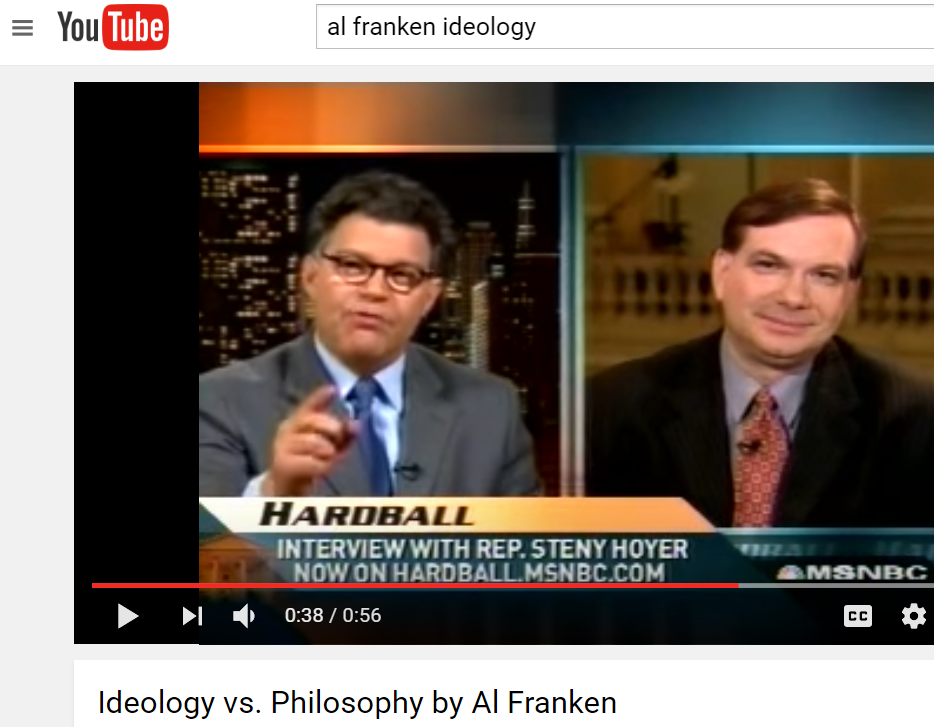
My concern about Lange’s assessment of representational ideologies is that it seems inescapable in scope.   While I think she’s correct that we have to account for the fact that any articulated political, religious or economic system has a center of power and boundary for inclusion or exclusion, to what extent then is any communication not propaganda?  More broadly, was Al Franken right in 2006 when stating that there is a legitimate valid distinction between ideology and philosophy.   If he is right that there is a valid distinction and that ideology is rigid and philosophy is open ended I think Lange’s articulation of representational ideologies needs more qualifiers as it gives me the impression that we are all perpetually entrapped within systems.   I would like to offer two examples, one practical and one conceptual, but both media oriented,  that demonstrate that having a philosophy is part of the Catholic tradition embedded within the larger ideology.    
After the commencement of the pontificate of Benedict XVI in 2005, there has been in the USA and at the Vatican an attempt to investigate the work, mission and agenda  of the LCWR, The Leadership Conference of Women Religious in the United States.   This has culminated in conclusions made during the pontificate of Pope Francis.   Throughout these proceedings the questions have included ideas such as, do women religious (commonly referred to as sisters or nuns) in the United States emphasize the full scope of the moral teachings of the Church in their apostolate(religious activity and ministry as lay women in the Church)?  Do they promote an ideology of feminism at odds with doctrinal teachings of the Church regarding the complementarity of humans as male and female? And a number of other questions.   So the representation ideology is indeed about the consistency and coherence of members of the Church having a united front in relationship to a secular world.  Yet at the same time this investigation, its precursors and outcomes reveal a more complex picture on what is ideologically acceptable and allows breathing room for philosophical diversity.  For women religious in the United States there has existed since 1992 two leadership conferences to which the leadership of congregations (religious orders) can collaborate and associate.   The older of the two, the LCWR, is the one that would be considered the progressive or liberal one and the newer is, the  Council of Major Superiors of Women Religious (CMSWR), is the more traditional or conservative one.  In the intervening period before investigations started, their co-existence seems to be a gift to the life of the Church in that these diverse approaches to religious life create  opportunities for community and service for women of a billion member strong world religion.   I find that such a diversity makes it incumbent upon me as a teacher of the tradition to expose my students to both the lives of St. Teresa of Calcutta (1910-1997) and Sr. Dorothy Stang (1931-2005).


3rd They Say:  From Renee Hobb’s Teaching about Transgressions lecture (3/6/2017)


Called the Scary Maze Game...out comes a a scary face and he freaks out...
And it turns out in that sharing of feelings emerges a discussion of representational ethics about what are the obligations between the filmaker or the digital author and the person who is being depicted and the audience... consent, free will, intentionality, consequences, social good and spectatorship...


3rd I Say:   As I lesson planner I am an author.   As a teacher in the classroom I am an audience member when we watch something together.   (I rarely can grade papers in the back of the room even if it is the fourth time I’ve seen a video as I want to be attentive to what unfolds in the viewing by that section of students.)   As the teacher who is challenged I am sometimes the subject.    I want to uphold the dignity of my students and preserve the common good of my students.   But I want to prank them occasionally.  I could rephrase that and say that I provide them with an awakening experience as described in the lesson planning format of David Lazear…


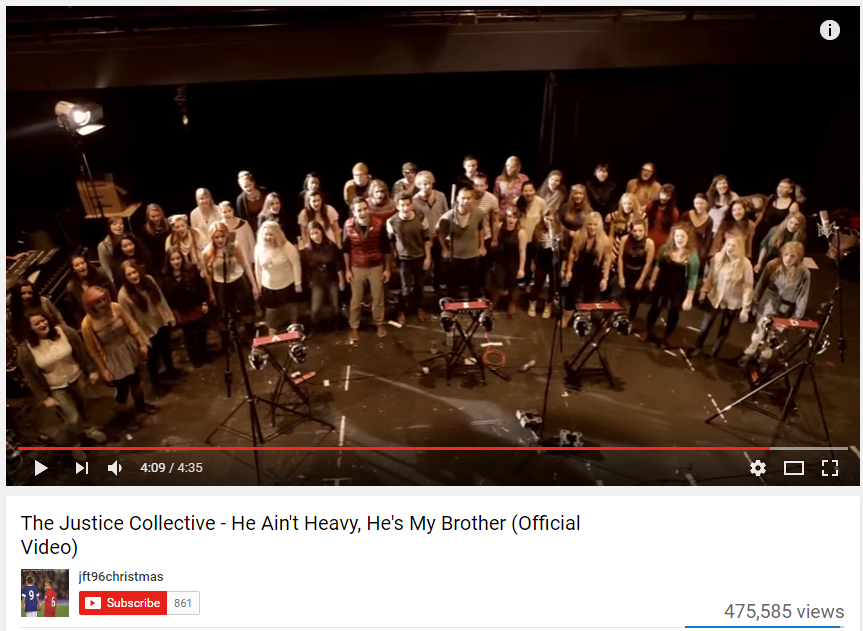
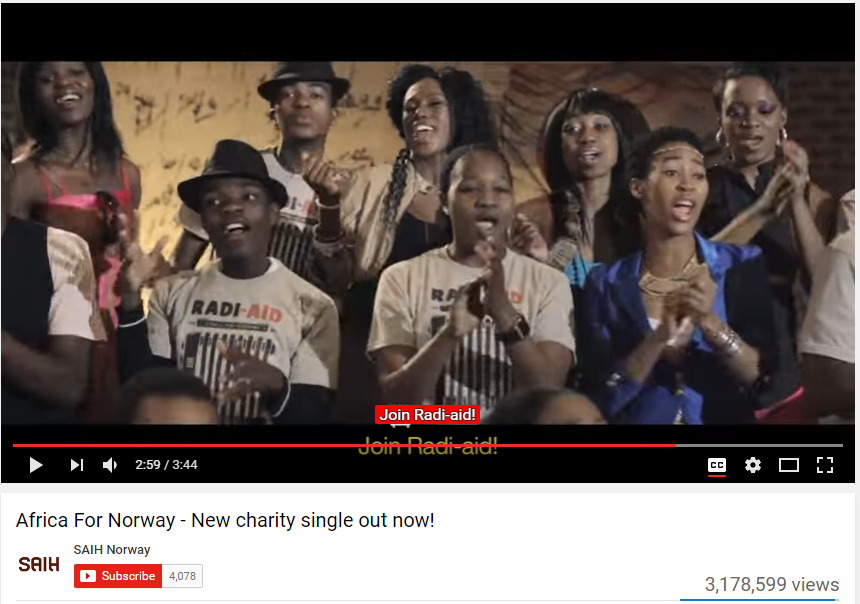
...So the past few years I have pranked my classes when we talk about the new organization some of them join, Young Men for Change, which seeks to raise consciousness about personal decision making and redefining masculinity.    I talk to them about why it is important to be truly invested in such an organization if they choose to join and not just take the path of least resistance and buy a T-shirt with the logo of that organization.    I tell them this after we watch first the 2012 Justice Collective video.  It is a British charity single covering the Hollie’s He Ain’t Heavy, He’s My Brother that the performers have recorded as they seek to help redress the injustice that lingers from 1989 Hillsborough disaster in England when ninety six people were crushed to death in a football stadium because of improper crowd control and management.  Right after they see that “good cause” video, I show them Africa for Norway by Radi-Aid, a fictional group actually made by the Norwegian Students’ and Academics’ International Assistance Fund.  Once students watch that I ask if they also want to get involved with this good cause of sending radiators to Norway to help those cold people just as some of the Africans have done in the video.   Eventually the conversation progresses to the point at which we have to talk about why Radi-Aid is not a real organization and why the video was a parody.   I have them put their heads on their desks and acknowledge by a raise of hands who thought the video was real.   Whether it is an accelerated or honors class I get about a third of each class to admit that they could not recognize the video as a parody or a fake or in some ways a prank on those who are not as media discriminating as others.   So ultimately my pranking student with a fake charity song/parody does not intend them any harm but rather as an initial inoculation against being unprepared for media manipulation and of course that brings it full circle to considering representational ethics that Lange articulates in that we discuss why Norwegians would be inaccurately portrayed in the Radi-Aid video as weak helpless people who can do nothing in their frigid plight but wait for the arrival of used radiators from Africa.    The song also includes the lyrics “Here in Africa we’ve had our problems too, with poverty corruption, HIV and crime, Norway leant a helping hand and now it’s payback time…”   We discuss how this is veiled criticism of the Norwegian or developed countries’ limited and stereotypical view of Africa.


I find that the most important thing happening to me in this course is that my intuition and skills are being affirmed as a critical educator.  I’m doing a number of things already in class to have my students move forward as digital learners, authors and conscious consumers, but I’m gaining new insights each week on how to name those realities.  I’m also well aware that the shift I need to make involving my students’ empowerment and move to a more constructivist classroom model so students can more actively engage in these processes and DO something or a number of things that are socially beneficial and personally rewarding.  
Works Cited
Armadilloze. "Ideology vs. Philosophy by Al Franken." YouTube. YouTube, 17 Nov. 2006. Web. 11 Mar. 2017.
Hobbs, Renee. "Digital Authorship." Digital Authorship. Professor Renee Hobbs, Harrington School of Communication and Media, University of Rhode Island, 2017. Web. 11 Mar. 2017.
Jft96christmas. "The Justice Collective - He Ain't Heavy, He's My Brother (Official Video)." YouTube. YouTube, 04 Dec. 2012. Web. 11 Mar. 2017.
Lange, Patricia G. "Chapter 6: Representational Ideologies." Kids on Youtube: Technical Identities and Digital Literacies. Walnut Creek: Left Coast, 2014. 157-58. Print.
Lazear, David G. "New Instructional Methods for Teaching with Multiple Intelligences." Teaching for Multiple Intelligences. Bloomington, IN: Phi Delta Kappa Educational Foundation, 1992. 24. Print.
Radi-Aid Awards. Norwegian Students’ and Academics’ International Assistance Fund, 2013. Web. 11 Mar. 2017.


Monday, February 6, 2017

My Media Memoir 2017


My Media Memoir 2017


It's not uncommon in New England or probably most parts of our country to have parents of different religious affiliations.   In fact, I have a first cousin twice removed who has the same story that I do. She had a Catholic mother and a Protestant father and we both ended up going to Protestant divinity schools in Massachusetts. But in her case her father practiced and in my case mine did not.  And that has been one of the ingredients in the recipe of my life and cultural heritage that for years made the taste seem slightly off.  Eventually, one nut would be added back into the recipe to get the taste to be refreshed and understood anew.


So I have lived all of my life in Massachusetts but that lone fact or the brief vignette above has not necessarily helped me answer the question of “who am I?”  


As a young person I had been familiarized by the traditional media of signs, monuments, and other markers that helped me get a glimmer of my own Anglo-American cultural identity because I knew growing up that my near namesake and great-great grandfather Daniel Luther Tucker and his father-in-law Conrad Spraker were buried across town in Spring Brook cemetery.   But compared to the many other ethnic Americans I have encountered in Bristol County, USA, I do not feel that I have had enough to go on in terms of having a solid identity.   I have had soup and bread at many a Portuguese festivals and similar events with local Greek, Egyptian and Italian enclaves but never had the sense of what it means to be an Anglo-American (working middle class person).   It doesn't help being mono-lingual also.   While I know the answer to this might be that dominant culture groups act and form this way and so there's no identity to find but I think that is an oversimplification.


I knew the name of Daniel Luther Tucker's son George Spraker Tucker and knew that through his wife Edna Delano our family was distantly related to FDR.  But that was about it.   My father's aunt Edith lived until 1999 and was a  pleasant person but we never talked about anything related to family more than her generation or one back from her.   My dad's first cousin Bob, only gone a fews years now, the aforementioned  Protestant father in my introduction, had a unique story of competing loyalties in his life so the Tucker side of his heritage was eclipsed by the Foster side.  But growing up I had two competing stories of cultural and religious commitment.  Bob and Edith, and a few others aside, we didn't see to much more of my dad's side of the family on a frequent basis. And despite my mother being an only child, it was the armies of French and Irish Catholic relatives, all of the Rheault's and Conroy's, that we regularly visited or were visited by during my childhood and early adolescence.   It was a full cast of characters.  Anna Conroy, my Irish great grandmother died in 1977 at the age of 99, just at the time by which I had locked in vivid memories of visiting her and my great aunt at their home in Roslindale, located at the highest point in Boston, on a side street off of the great incline that is Metropolitan Avenue.   I met Madge there, an Irish cousin, who visited two three times during my early years.  I met the majority of my grandmother's eight brothers and sisters and saw them again at the various funerals and anniversaries that followed rather quickly after my great- grandmother's death.  


On the French side of my mother's family we saw cousins and aunts and uncles on a less frequent basis, as they all tended to live in points north of Boston and we had always lived south of the city.   But it was my grandfather and grandmother's involvement that would be vital to me being a Catholic and by all accounts a zealous one, all the while bearing this English (Protestant) last name. Visiting my maternal grandparents and staying overnight with them for a day or two was the full on Catholic media practice and production.   We bolted to Daily Mass  Saint Anne's Church in Hyde Park right out of the starting gate (pre-breakfast of course!).   We sat in the second row behind the middle aged man in the red sweater who had wobbled in place during the whole liturgy.   We returned home for breakfast in Dedham and went about the regular routine of a few chores in the house and a bike ride through the hills of Dedham and everyday was closed by the recitation of one mystery of the Rosary while kneeling beside my grandparent's bed with the massive gold colored Douay Challoner Catholic Action Edition Bible open to some page with a fully painted picture of a New Testament miracle on one side of the page or the other.  


Despite this Catholic media immersion my grandfather was the one who bankrolled my nursery school tuition at the only available location in Mansfield, the Congregational Church. Granted, I was not going to be swayed by Protestant doctrine at the age of three, but this was an a
choice from the  same man who sent my mother to Catholic primary and secondary schools out of a sense that failure to do so would be the loss of his own salvation.  Were he to know that it might be a portent of things to come and that the other bookend of my formal education
was Andover Newton Theological School, the Congregational seminary, he might have felt differently.   


But I grew up, attended Sunday Mass all along the way, and I was eventually encouraged to attend a divinity school by a Catholic priest while at college (thinking I could teach or be a good candidate for the State Department) and eventually began my teaching career in Catholic high school theology departments.   Now it was there that it became clear it that it would mirror parish life in that I would be the only one of a few at most who's last name was clearly not Irish or Italian.  Not long ago I taught with three Italian American's in the same department and one of them joked that the department should just be renamed "Goodfellas".  


So granted, I had been steeped in the Continental and Hiberno European cultures all of my life but had felt that there was something missing in my self-understanding about my heritage.    But that started to change quickly seven years ago when I visited my parents one afternoon.  
They had come into possession of a document that would set me off on a mini-media adventure that recast myself understanding and relationship to my surroundings.    As usual that afternoon my mother put the kettle on for me as she did for my Irish American grandmother when she lived with us in her declining days.   Tea seems to have always been the linking theme between my Irish and English ancestries.  What else would or could be?  Well as I said earlier, it was a nut.  It was Almond Tucker.   As I’ve said before I knew about all of the recent Tucker generations at least in outline form.   But I had at the time a limited sense of my own abilities to find anything else and a few dead end searches online seemed to cement this barrier to further knowledge.  Ironically, the nut, Almond Tucker, cracked that prematurely cemented barrier.    


The document in question was Daniel Luther’s death certificate and listed his father Almond on the document.   That was a new name when it rang in my ears.  I immediately got a sense of what was possible in returning to research I had given up on not long ago.    My curiosity was now at a fever pitch and when I returned home I was eager to look up his name and did indeed find that there was substantial reference to him in local history and quite an amount of work done by those who shared him as a common ancestor.  


So in about five months I was able to visit numerous websites to trace the Tucker lineage in many directions.  Importantly, it became clear to me that I could shift from being a digital reader or consumer by finding this information to becoming a digital author.  I recall from last semester’s Digital Literacy Seminar with Dr. Julie Coiro that an internet reader reads and creates a new unique text into existence by taking his or her own course throughout the various hyperlinks he or she chooses to follow in the pursuit of knowledge.   I knew this would be the case for me also as I would be creating a genealogy that would include its own unique subset of persons (my children)  and that it would be a unique document in that I would be likely emphasizing a set of relationships no other person could make.  


So yes, I confess, and I realize now seven years after beginning the genealogy there is unquestionably a degree of self centeredness in the approach I took to making it.  
For while I modelled my work on that done by others, distant relatives, who were comprehensive in their work I choose not to focus on any cousins, aunts or uncles.  Yes, I found delight every time I would use the internet or the genealogical records to find a direct ancestor either through patrilineal ar matrilineal descent.   And more to a point, I was looking to find as far back as I could with direct descent with the Tucker line. I have to admit it was a sheer genetic greed that possessed me when composing the genealogy and attempting to believe it was possible to go back to pre-Reformation times in England.  That would of course mean I would be looking at Pre-Reformation Catholic Tuckers.  They may have been Lollards (followers of Wycliffe) but I do not want to think that.   So when it comes to the year 1678 and the origin of the first Tucker’s in America I wrestled with which other genealogy to follow and even accept some contradictory or ambivalent evidence that would ensure my landing back in England with an intact Tucker line.  Yet some of those webpages and other sources spoke of this or that Robert or John Tucker being born in Weymouth or Milton, Massachusetts but dying in places like Bermuda.  As memoir has creativity and a bit of license, I know genealogy really cannot be constructed in that way.  I have this sense that the temptation to have the various records be something that I can master for my own ends as opposed to letting the facts master me I came face to face with the true nature of critical literacy as really is.  Buckingham states that it involves, analysis, evaluation and critical reflection.  (Buckingham 2003, 38)   In all my years of divinity studies I never really felt the need to dispense with any one or all three of these critical processes.  But it was now apparently all worth it to make this genealogy right.


That all being said, it is clear as I reflect on this now and  that I have given a position of privilege to my own last name it is only  a way to direct one’s attention to an accident of history.  Who am I?  Yes, I’m a Tucker and a Priestley and Delano and a Hathaway, Eddy, Allen, Weed, Davis, Hinckley, Spraker, Newland, Simmons, Hunt, Copeland, Eddy, Hinckley, Samson, Standish, and Alden, etc. etc. etc. etc…..


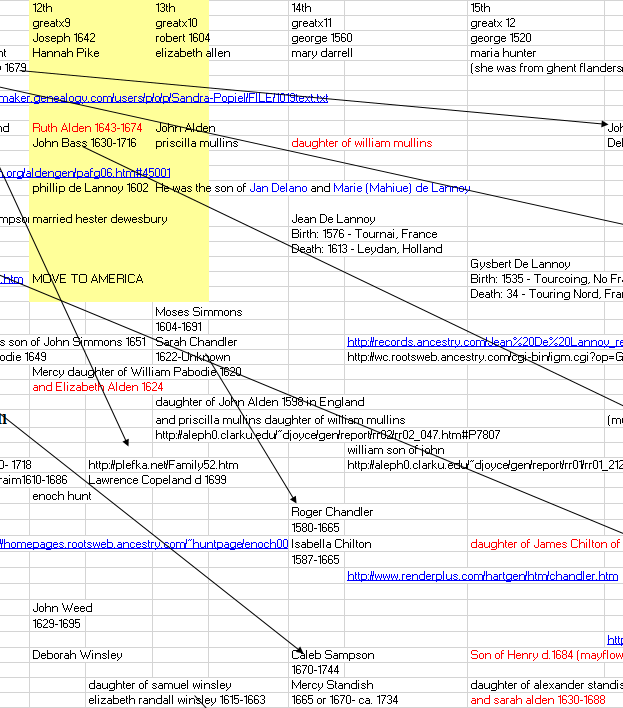
And before I continue on with the last name on that list, Alden, I want to address the new media frontier for me in all of this.   Since I was focusing primarily on direct descent and I am most certainly a visual learner I decided that putting everything I found on a single spreadsheet page.  The web of relationships to me was the main attraction to be seen.   Granted, I found much information from the work of distant cousin (probably an eighth or ninth cousin) and I was impressed by the thoroughness of his work and his genealogical procedural precision.   He has properly numbered everyone as one should in composing a genealogy online, using proper pages to distinguish generations.  It’s clearly an impressive and comprehensive work.     I found that I wanted to use Excel because it meant a visually striking and complex web could be viewed on one page.   Of course I discovered there are trade offs in doing this.  It means drawing a bunch of lines off of various lines to capture the complexity of different lines or going ahead and making patrilineal or matrilineal lines branch down from previous rows with the flip side of that gambit being that the spreadsheet would be enormous and unviewable in another way.   Either way, my consciousness as a writer and author.  Granted, I was happy to learn about my own personal narrative, expository and poetic strengths when I took the course Writing from Soul with Nita Penfold at Andover Newton in the summer of 2008.    But in this case becoming an archivist, a researcher, an organizer, and somewhat of an editor seemed to be empowering and ennobling in a new way.   In the early 2000’s my only experience with MS Excel was limited to being the debate league statistician and manager of our household finances, both of which were about cultivating new types of headaches than it was about getting acquainted with a new type of knowledge and a new type of data organization. Since I first laid   my eyes on that death certificate to the time when I retitled the file I was storing all my information on was about five months.   At the time my youngest child was five years old and the house was a busy place filled with the laughter, energy and conflict you would expect in house with three little boys.   But when I carved the time out to keep generating the spreadsheet genealogy after the boys were put to bed, I had a keen sense of flow in putting it all together.  


On some level I do not share the priorities with that distant cousin who provided me with so much work but his work did also help me reach my goal of having a deeper meaning for the Anglo-American identity that lurked beneath the surface of my conscious life.   And even though I would find numerous Anglo-American ancestors as he did,  I came to understand that the Protestant heritage was actually more determinant in my existence in spite of all the Englishness.   I saw that just a few years generations back that my families of origin had regularly been willing to be intermarried with Germans, Swedes and notably, as I will explain later, the Dutch. And of course all of those peoples in the nineteenth and twentieth century were Protestants.  


However, so while my Anglo-American identity has not been clarified with these discoveries and connections, I have now come to realize more concretely what it means to be a New England Yankee.   For it was easy to find the Delano line online and trace it back to before the time Delano was Anglicized from De Lannoy, the last name of the young Dutchman, Phillippe, who came over on the Fortune in 1621.    And more importantly, when checking my distant cousin’s work it took a number of days to get through my thick head that John Alden was a name that should have been more familiar to me.   That was the big one!  A Mayflower ancestor, in light of his many children and illustrious career, THE Mayflower ancestor (or so I thought for a brief time).  But as it turns out I could find and organize more and more names. When all was said and done I could identify six distinct Mayflower names of people who were my direct ancestors; Chilton, Samson, Standish, Cooke, Mullins and Alden.   Of course if there was one it makes perfect that there were six.   So I placed them on the spreadsheet and set them off as unique by labelling their names in red.   I had done similarly when accounting for immigrants the best I could with a line extending top to bottom of those who crossed over from England (or in this case,  the Netherlands).


I had add further red to the genealogy as the well known John Alden did not provide me with a daughter to be my great xth grandmother but three.   So Elizabeth, Sarah and Ruth Alden all married men who would eventually have descendants who would intermarry with other cousins to produce me and thousands of others.  I mention this because I think it’s with this  visualization of the data on a spreadsheet it seems to make sense of my Anglo-American, specifically Yankee, identity.    I don’t call Framingham and Natick Central or Western Massachusetts as some do in the eastern half of the state but it makes it clear to me the degree of rootedness I have in this area.   Since the Mayflower landed 397 years ago I’ve been able to move my ass all of thirty one and a quarter miles to the west of the Alden House in Duxbury.   This rootedness may be inescapably deep.   After putting this all down electronically has motivated me to get a closer lay of the land and just now to measure out things I knew were significant.  I was baptized at St. Mary’s in Norton all of one mile away from where Almond Tucker was buried in 1865 and his father Benajah was buried four years prior.   I have read Kevin Leman’s books on birth order and I always had the impression that as a first born son I was meant to most likely “stay in orbit” around my parents and be family oriented.   Yet when I look at the Tucker genealogy and the patrilineal descent and compare it with the online resource I could find such as Representative Men and Old Families of Southeastern Massachusetts: Containing Historical Sketches of Prominent and Representative Citizens and Genealogical Records of Many of the Old Families of Southeastern Massachusetts. Vol. III.  it became clear that with exception of my father, grandfather and great grandfather, the Tucker men have been in northern Bristol County since arriving from England in 1678.   When my wife in and I moved in 2014 within Bristol County I joked that even though we looked at houses further north, somehow an invisible barrier prevented us from leaving Bristol County.    We are now just about four miles west of where Almond and Benajah lay resting.    


I think that one final insight that comes to me from creating this spreadsheet genealogy to share with family and interested kindred spirits has been to know the continual enduring power of privilege.  I am a white man living in the twenty first century studying mainly white men going one, two or three centuries back.  And so I now have about two hundred people listed in the genealogy and I do want to revisit it again to make some organizational streamlining.    Yet ironically the male privilege that I possess in life today and those of my forefathers came into sharper focus in attempting to give Almond Tucker’s wife, Betsy Hathaway, the same due diligence I gave to others in the list.   Betsy was from Dighton and had eight children with Almond, but nothing is available on her origin whatsoever.   This motivated me enough to be as multimedia oriented as possible and use every public website and the archival books and town records of the Dighton Public library, which one would surmise would have a little more information in it’s Vital Records collection than other towns.   Alas, it was not meant to be.  My first thought after running into dead ends in search of Betsy was that it may only make sense that daughters were simply not as valued equally to sons in tracing lineages because of property rights and the social customs of the day. I gather that being an amateur genealogist and professional information scientist in the twenty first century along with being this hybrid Euro-American Catholic believer Yankee Protestant cultural warrior all call me to be a dignitarian who will attempt not to discount anyone, especially in a day and age when women seem to have a new fight for equality brewing that needs allies and equal partners.  

Buckingham, David. "Media Literacies." Media Education: Literacy, Learning, and Contemporary Culture. Cambridge, UK: Polity, 2003. 38. Print.